Category: Writings

I have written all of my life and this collection will be diverse in content and genre.

Zebrafish Research: A Clear View of Life’s Beginnings

The Wonder of It All… Zebrafish Research: A Clear View of Life’s Beginnings

By Pat Edwards
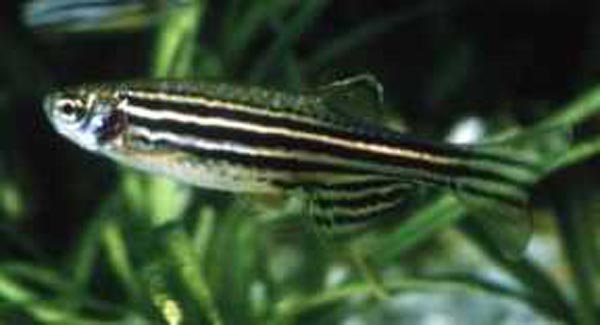
zebrarfish

Through the lens of the microscope, the crystal-clear egg with its single cell sitting on top of the yolk sac, looks like the fringed bald pate of a monk. Before watching eyes, it begins to divide. In a little over an hour, its eight cells resemble the ruffled comb of a chicken. In two hours’ time, there are 64 cells, and at three hours, 1,000 cells sit tightly clustered together. By the 9th hour, a body begins to take shape, wrapped around the circular shape of the yolk sac, tip of tail nearly touching top of head. By the 17th hour, the tightly curled embryo begins to open like the blossom of a flower. At the 30th hour, the huge unseeing eyes are visible in the massive head. As each hour passes, the embryo’s body begins to straighten more and more and takes on the characteristics of a fish. Soon, a mere three days later, the wriggling, live zebrafish is ready to begin life in its aquatic environment.

ZF staging

During the early stages of development, dye can be injected into a single cell. As it divides, the cell’s “daughters” also bear the mark of the dye and with the help of a microscope, their migration paths can be traced to where they are destined to grow. But, is that destiny, or fate, determined by the cell’s ancestry or by its environment? What would happen, for instance, if the normal migration path is blocked? Will the cell’s migration take a detour and arrive at the predestined point? Or will it veer off in a completely different and unscheduled direction? What happens if the “mother” cell is moved to a different location before it begins dividing?

This type of research is described as a quest to discover whether cells in an embryo follow the “European” or “American” plan of development. If cells follow the European plan, their fate is determined by their ancestry – whether their mothers and fathers were kings and queens.

If they follow the American plan, however, their fate is, in large part, a result of environmental factors. Their destiny is determined not by their lineage but by changes that occur in their environment These are some of the questions that are being asked and answered in the study of the “hottest” new model in current developmental research, the common, ordinary, home-aquarium-variety of tropical fish, Danio rerio, or zebrafish. And, for those whose curiosity has been piqued, the answer to the cell-tracking question relating to the European vs American plans described above has now been proven… the correct answer is the American plan.

I became indirectly involved in zebrafish research a few years after I was hired in 1989 by the Institute of Neuroscience at the University of Oregon as their secretary. Five scientists connected with ION began a collaboration in the study of the developmental biology and genetics of the lowly little zebrafish. They asked me to work directly with them as their secretary. Their predecessor, a molecular biologist at the UO, Dr. George Streisinger , is considered by many of his peers to be the founding father of zebrafish research. As a fish hobbyist who knew how easy it was to raise and maintain zebrafish, he began using it as a model system. The fish was small enough to keep the large numbers required for genetic studies, but large enough to do classical embryological manipulations such as transplantations. Before his death in 1984, he had published a paper on his work in a major scientific journal and the seeds of his research began to sprout throughout the world. By the time that I retired from my position as the administrative coordinator for the International Zebrafish Research Community in 2004, there were hundreds of major labs around the world using the zebrafish for developmental biology and genetics studies.

The group of scientists who hired me included Dr. Charles Kimmel, a developmental biologist who had worked directly with George Streisinger. He was a winner of the prestigious American Association for the Advancement of Science Fellowship award for his work in establishing the zebrafish as a model for mammalian development; Dr. Monte Westerfield, who designed and maintains a vast on-line database to collect the findings of the international labs and who was instrumental in overseeing the construction and maintenance of an ultra-modern zebrafish breeding facility at the UO; Dr. John Postlethwait, a renowned geneticist whose lab began work on the zebrafish genome project; Dr. Judith Eisen, a developmental biologist who studies motoneuron development of the zebrafish; and Dr. James A. Weston, who originally studied neural crest development in the mouse and joined forces with the zebrafish group, adding his experience in obtaining and administering its first million dollar program project grant for the collaborative effort. Another of the original researchers in the University of Oregon group was Charline Walker Durchanek, a senior research associate who worked closely with both the Streisinger and the Kimmel labs, discovering many of the zebrafish mutants used worldwide today in the study of birth defects.

Most developmental research has been done using models such as Caenorhabditis elegans, the nematode worm, or Drosophila melanogaster, the fruit fly. But, as valuable as the research on these models has been, they are invertebrates. The results of basic research on the zebrafish, a vertebrate, can relate much more closely to more complex vertebrate systems including humans. One of its eventual implications for humans is a possible means of finding ways to prevent birth defects. And, unlike other mammals that develop within their mothers’ bodies, the live, developing zebrafish embryo can be viewed under a microscope.

Even though this is a study on zebrafish, it’s a simple model for humans. Because of the complexity and danger of studying live human embryos, scientists are always looking for a way to use simpler models. Mice have long been used, but like many mammals, the forming babies are encased in the womb of their mothers and are difficult to study while they are actually living and developing.

According to Dr. Charles Kimmel, “Fish and mammals are ancient relatives, having evolved from a common ancestor. Most vertebrate embryos are strikingly similar in their early stages. Though there are different body parts between a fish and a mouse, you find a lot of their genes are similar, thanks to that common ancestor.”

At the teaching level, high school and community college science instructors are beginning to discover the benefits of using zebrafish in genetics and development projects in their classrooms. Many valuable lessons can be learned from actually watching an embryo develop and grow from a single cell into a mature adult.

My experience working with these pathfinders was humbling. Before being hired at the UO, I had no background in science, no experience with international relations. During my 15 years at the University of Oregon, I met and became friends with scientists all over the world. They are a wonderfully diverse group of people working together toward a goal of understanding not only fish development and genetics, but that of humans, as well. These scientists opened the international doors of respect and friendship to me. I traveled to scientific conferences at Cold Spring Harbor, New York and coordinated conferences closer to home; I helped put together the multi-million dollar grants that still fund this research today. I feel so fortunate to have taken even a minute part in what I am sure will someday be major medical breakthroughs by these dedicated scientists.

I’ve learned that science is not only knowledge. True science, stripped down to its basics, is the pursuit of answers to questions. In the study of biology, those questions must originate in the very beginnings of life. Technology is providing better and more precise equipment to seek the answers, but Mother Nature must provide those life beginnings in a form that can be studied. In the zebrafish, she has offered a most perfect specimen.

And because of the common, ordinary, home-aquarium-variety of tropical fish, Danio rerio, humankind may someday benefit.

Printed in Volume 5 Issue 3, Groundwaters magazine, April 2009
Moments of Valor: Lloyd Counts: A Silence is Broken

Lloyd Counts: A Silence is Broken

By Pat Edwards

In 1945, when he returned home to Lorane, Oregon following World War II, Lloyd Counts tried to tuck the memories of the preceding five years into the past. For the most part, he succeeded. He had a new wife at home, a house to build and a family to start, so the process of living took precedence and overshadowed those five years with the U.S. Army. But, the memories remained and would surface occasionally. When asked about his experiences during the War, he said little, keeping the memories close inside, not wanting to share them with others. It was his feeling that what he did was such a minute part of the effort, that by talking about it, he would make his role seem so much more than he felt it was. Besides… many of the memories hurt.

The older he became, however, the more Lloyd wanted to share some of his experiences with the younger generations. He felt that his experiences and those like his should be told. After becoming quite upset at recent claims in the news that the Holocaust never happened, Lloyd knew that it was time to tell his story. He approached me at Lorane’s Old-Timer’s Picnic in August 2008, asking if I would be willing to record his memories. I agreed, but it wasn’t until the following February when I finally sat down with him in his home in Lorane.

In 1939, before the U.S. entered the War, Lloyd enlisted in the U.S. Army and was sent to Panama. He joined the 82nd Coast Artillery, an anti-aircraft unit that set up guns in the jungle in case enemy planes should pass by on the way to the United States. Fortunately, the guns in Panama were silent while he was there. Lloyd was stationed there when Pearl Harbor was attacked and after four years, he was furloughed back to the United States where he married his childhood sweetheart, Estelle Mitchell.

Soon after their wedding, Lloyd was sent to Texas and then Mississippi where he joined the 861st Artillery Battalion at Camp Van Dorn, Mississippi. From there, he was sent to New Jersey where his unit boarded the U.S.S. Washington, a former civilian vessel that had been converted to a troop transport. On board the ship, he was reunited with a former classmate from Lorane High School. Russell Hensley was a sailor with the U.S. Navy at the time and served onboard the ship. He had been to Australia on a previous voyage and presented Lloyd with a sheepskin vest he had obtained while there. Lloyd said that there were many times when that vest kept him warm and protected in cold weather.

The U.S.S. Washington sailed for Europe with troop members crowded into bunks stacked so closely that their noses almost touched the bunk above them. Lloyd was assigned dreaded KP duty, but Russell interceded and got him a job directing traffic on board the ship.

When they arrived in Marseilles, France, Lloyd joined the 105th Field Artillery Cannon Outfit as a gunner. He and others in his unit hauled the huge, heavy cannons and equipment to the top of hills behind Marseilles where they had to clean off the cosmoline that was liberally smeared on the metal to prevent rust before the guns could be fired.

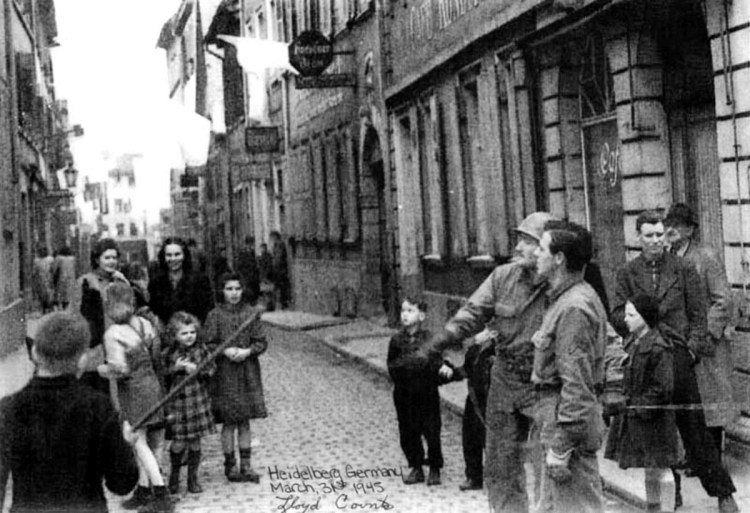
Lloyd in Heidelberg

Lloyd Counts, age 24 (right forefront) after arrival in Heidelberg, Germany. Note
the white surrender flags hanging from the buildings.

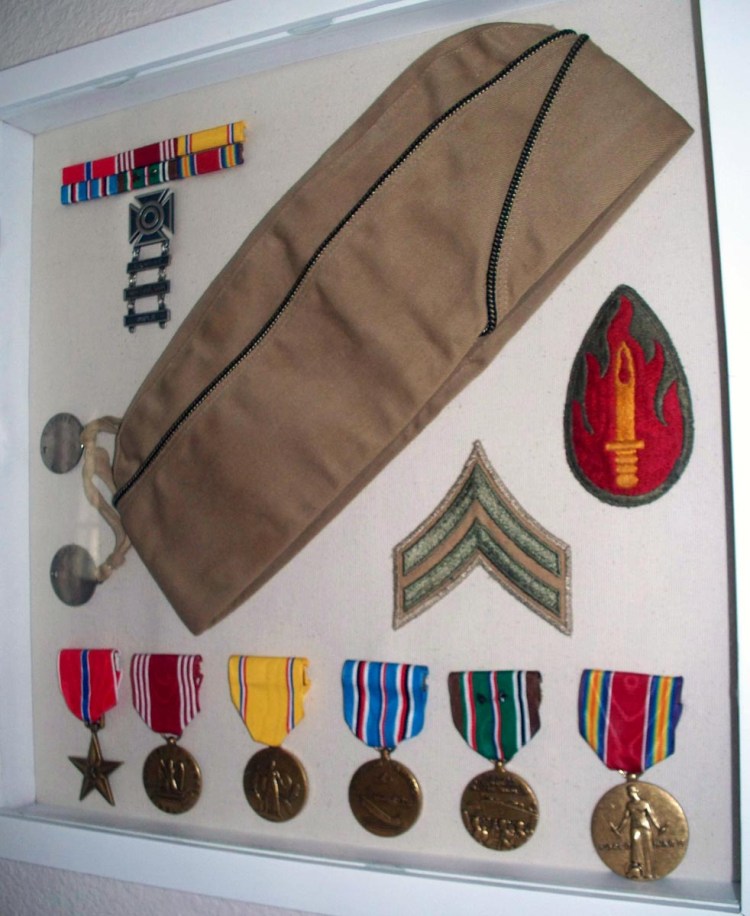
Shortly thereafter, however, Lloyd joined the “Champagne Campaign,” laying communication lines through the wine country of France and Germany. There were no cell phones in those days. Lines connected the forward observers to the division leaders so that they could report what was ahead. There were occasional skirmishes along the way, but it was at what was called the Siegfried Line along the border of France and Germany where Lloyd obtained first-hand experience with the horror of war. The Siegfried line was a 390-mile defense system built by Hitler on the western border of Germany. It was lined with over 18,000 bunkers, tunnels and tank traps. At 1:00 a.m., with a one-mile reel of wire on his back, Lloyd set out with the infantry he was with to traverse a main crossroad to lay line. They made it across and laid the line, but ran into trouble on the way back. There was a lot of ground fog that night and for the purpose of “blinding” the enemy to the return crossing, bright, 4 million-candle power searchlights, were directed toward the sky. Instead of blinding the enemy, however, they highlighted their own position and huge exploding shells rained down upon them. Lloyd and another man were riding on the fender of a Jeep when the percussion of one of the shells sent them flying in two different directions. Fortunately, neither of them were badly hurt, but Lloyd sustained a piece of shrapnel in his leg. The difficulty of the assignment and the ensuing skirmish earned Lloyd a Bronze Star that night.

As Lloyd’s unit advanced across Germany, they saw more and more signs of Hitler’s horrific reign. His treatment of the Jews, especially, was there for all to see. Lloyd paused in his story at this point, struggling to regain his composure… it was obviously extremely difficult for him to continue. But, this was the story he felt he needed to tell…

“I saw more dead bodies than I ever thought I would see. There were places where we came upon huge piles of bodies waiting to be incinerated. Most had been starved and worked to death. One day, several men from our unit went to a railroad siding close by to view at least 50 boxcars crammed with more dead bodies of Jews. I didn’t go with them – I had seen many more than I ever wanted to see.”

One day, they came upon a concentration camp filled with Polish citizens who had been there for over four years. He remembers the people in the camp watching the soldiers as they ate and afterwards they began digging through the garbage for any remains of food that they could find to eat. When the soldiers realized these people were starving, they gathered together as many mess kits as they could to give to them. After they left, the prisoners were freed from their captors by the troops that followed.

Occasionally, they came across other camps of forced laborers. Even though they had been left to fend for themselves, the people of the camps would not leave because of their fear that the Germans would return to punish them. The Holocaust was, indeed, real.

Lloyd was one of the first ones to enter and occupy the German city of Heidelberg. He had to string the phone wire high on the buildings to prevent them from being damaged on the street by tanks and other vehicles. The accompanying picture of Lloyd in the foreground shows welcoming civilians and white flags of surrender on the buildings. Two men standing in the background were probably German soldiers in disguise, according to Lloyd.

As they got deeper into the German countryside, they came across the vast and sturdy autobahn highways that served as landing strips for the first jet aircraft that Lloyd had ever seen. The centers of the autobahns were painted green and maintenance shops for the aircraft lined the road under the shelter of trees.

Lloyd’s trek across France and Germany took 6 months. His tour of duty ended in 1945 at the Danube River when the Armistice was signed and his division was pulled out. Lloyd was one of the first ones sent home to rebuild his life with Estelle about three weeks later.

Lloyd sums up his experience haltingly. “Fighting a war is a team situation… everyone does his part… even those who stay home. I wouldn’t recommend any of the things I did to others, but young people should take notice of the stories that we are telling. Our experiences should be recorded and remembered so that hopefully, someday they won’t have to be repeated.”

Lloyd Counts medalsLloyd missed the ceremony in Germany after the war when medals and ribbons were handed out. His military records were lost in a fire at the National Personnel Records Center in St. Louis, Missouri in 1973, so it was only through diligent effort on the part of his daughter, Vicki, that he was finally awarded his medals in 2008 – 63 years after he returned from Europe. In addition, he was able to obtain the Heidelberg picture from the archives of his division only a few months before our interview.

Printed in the Volume 5 Issue 3, Groundwaters magazine, April 2009
Sweet Lorane Community News, November 8, 2018

Fern Ridge Review
Creswell Chronicle
Sweet Lorane Community News
November 8, 2018
By Pat Edwards

My brother, Jim Burnett Sr., aka Jimminy Cricket in Groundwaters, is dying. He’s in the end stages of terminal esophageal cancer and has been told he has only a short time remaining.

Yesterday, my sister Barbara (I call her B.J.) and I drove to Vancouver where Jim and his wife Jonni currently live, to spend some time with him. He is no longer able to eat or even swallow and has not eaten anything considered “food” in about 2 weeks. He’s been existing on ice chips and up until yesterday, occasional sips of warm tea. Yesterday, the tea would no longer go down.

Despite all of that, we spent those seven hours talking, laughing, crying and sharing portions of our lives together that we have either kept hidden or have just not shared until now. Most of the talking was done by Jimmy. He seemed to need to open up and talk about his life and the parts of it that he has carried with him during his 81 years… his blessings, his regrets, his feelings of inadequacy, his proud moments, his sorrows and above all, his love for us, his family, and the many friends he has gathered over the years.

He talked about his frustration that none of us get a chance to take part in our own celebrations of life, and how he is reaching out to as many of his special people as possible via phone calls and emails to touch upon these special relationships one more time. He showed us pages of printed email messages that have begun to pour in to him from former co-workers, people whose lives he touched as a minister, and others he has not seen for some time. He sent them messages, telling them how each has touched his life in special ways and, in essence, to say goodbye.

Jim shared with us not only his acceptance, and even, excitement, of the journey he is about to take—“It’s time to set out on a new adventure.”— but also admitted to his nervousness about the actual process of dying.

Next Tuesday, he will be moving into a beautiful hospice center located close to his and Jonni’s home in Vancouver where he will be lovingly attended to until he is called home.
Just before B.J. and I wrapped ourselves in his wonderful hugs and said our “See you laters!”— not “Goodbyes”—he began to ask me to send word to our Groundwaters family of his great appreciation for the experiences that Groundwaters has given him over the years. While trying to get the words out, he broke into tears. Taking on the persona of Jimminy Cricket in the “Philosopher’s Corner” of each quarterly magazine and now the annual anthologies gave him a voice and a connection to each of you that he has long carried in his heart.

The only gift I brought to him yesterday, besides my presence, was the newly published 2018 Groundwaters anthology which he lovingly looked through as soon as I presented it to him.

I know that he would love to hear from any of you in a message sent to his email address of dadburnett13@gmail.com. In that way he can feel that he is participating in his own celebration of life.

Thank you all for your kind words to me and the concern that you have shown for his well-being. He’s in good hands.

Godspeed, Jimminy Cricket—Jim Burnett Sr.—my brother!