Coyote Ridge Dressage: A Link With the Past
By Pat Edwards
Lorane’s newest arena, Coyote Ridge Dressage is its best-kept secret. Built over a four year period and completed in 2006 by Greg and Tracey Weiss, it brings to the area Old World traditions and the elegance of European royalty. It is a new facility, but its roots go back 425 years in history to the very beginnings of the Spanish Riding School in Vienna, Austria – the home of the Lipizzaner horse and a very special classical dressage riding and training technique perfected by masters over the centuries. It links Lorane’s history to the 1936 Olympics in Germany where Alois Podhajsky, Director of the Spanish Riding School, won a Bronze Medal in Individual Dressage on his horse, Nero. General Patton enters that history when his troops rescued the great Lipizzaner stallions from capture by Hitler as depicted in Walt Disney’s 1963 movie, Miracle of the White Stallions. He rescued the mares, too, which were scheduled for slaughter to feed the troops in Poland. Podhajsky, Patton, and Tracey Weiss are all linked together by a single person, Tracey’s mentor and trainer, Karl Mikolka. In a short biography that Mikolka has published on his website, http://www.karlmikolka.com/, he tells of his beginnings.
“I, Karl Mikolka was born in Floridsdorf, a suburb of Vienna, Austria in 1935. My mother informs me that as young as my stroller days I exhibited an insatiable curiosity about horses, a curiosity that later became the driving force behind my entering the Spanish Riding School after graduating from the Humanistische Gymnasium in 1955. Dashing my mother’s hopes of ever becoming a concert pianist or something useful like a banker, I remained with the Riding School for 14 years, moving through the ranks of elévè, Bereiteranwärter, Bereiter and Oberbereiter or Chief Rider before accepting an appealing offer from Brazil to establish a nucleus of Dressage in Rio de Janeiro and Sao Paulo.
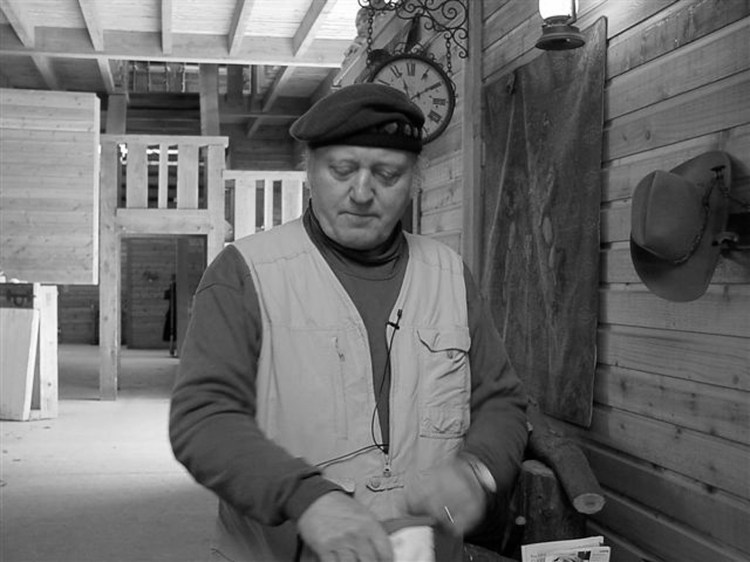
Karl Mikolka at Coyote Ridge
“In 1972, following my four-year assignment in Brazil, my good friend Richard Ulrich made possible the realization of my boyhood dream of coming to America by inviting me to join him at Friars Gate Farm in Pembroke, Massachusetts. The United States has been my home since then and I have devoted the past thirty years to the preservation of Classical Horsemanship in word and deed through training, teaching, judging, coaching and publishing. I now live in Gloucester, Massachusetts, with my lovely wife Lynn and three very charming and spoiled cats.”
Karl studied under the great master Cerha, who Podhajsky also had some earlier instruction from, learning the intricate and precise techniques used in classical dressage. On his summer holidays and other rare free times from the Academy, he sought out past masters who had retired but were still living in Europe. He spent whatever time he could with these past masters, learning as much from their lines of expertise as he could. Each master had his own specialty in the training process and by learning what he could from each of them, Karl has become perhaps one of the greatest repositories for Classical Dressage ever produced by the Spanish Riding School. Over the past 12 years, he has been passing that knowledge to his protégé, Tracey Weiss, of Lorane, Oregon.
Tracey was like many young girls growing up in Eugene. She was a city girl, but had a deep love for horses. Her parents bought her first horse, a Quarter Horse named Kemo, in 1971 when Tracey was just entering high school. They boarded Kemo at a local stables and Tracey began riding him in gaming events. She eventually began riding English and competing in hunter/jumper classes with her Holsteiner gelding, Blitzkrieg. Soon, she took up dressage. Her riding abilities and her love for horses steadily progressed until she met Karl at a Salem Dressage Clinic in 1996. They developed a friendship and a mutual respect and admiration. She recognized Karl as a great master who could expand her knowledge of classical dressage beyond anything she had yet experienced. He saw in her the potential to pass on the knowledge handed down to him.
In 1992, Tracey and her husband Greg bought a home and 35 acres of property north of Lorane from Randy Joseph. Allen Van Zuuk built the house and an outbuilding in 1976. Randy Joseph purchased it from Allen and added five more outbuildings and the main house.
Greg, an accomplished skier and a former owner of Wasatch Powderbird Guides helicopter ski guide service in Snowbird, Utah, and the Springfield Rock Quarry in Springfield, Oregon, decided that it was time to devote his energies to helping Tracey with her calling. As Tracey’s interest and commitment to the study of classical dressage became a total mission, the need for a proper facility became apparent.
Reminiscent of the 1989 movie, Field of Dreams, and its catch-phrase of “Build it and they will come,” Tracey and Greg built their dream. In Field of Dreams, Kevin Costner‘s character followed his seemingly unrealistic dream to build a special baseball diamond in the middle of his cornfield in order to attract the great baseball legends of the past. Tracey and Greg’s dream is bringing the past to Lorane. With advice from Karl, they designed and built an arena to perfectly aid in the training of the dressage horse.
Construction of the true timber all-wood frame building began in 2002. At first, they were told that a building that size could not be built with wooden trusses and without nails, brackets or bolts. Engineers carefully studied the plans, however, and were surprised to find that it could, indeed, be built that way. Local resident, Greg Morrow was commissioned to build the framework using large wooden dowels and wooden shims to connect the massive beams and structure. Jeff Faville, a Doughty grandson, is another local craftsman who took part in the creation of the building. He did all of the intricately patterned brickwork used throughout the building. Two former Lorane residents, Randy Joseph and John Jones, provided custom woodworking. Lorane resident, Parry Kalkowski used his talents in specialized metalwork to design the huge metal hinges that support the 1,000-1,100 pound doors leading into the arena proper. The exterior doors are also supported by metal tension rods designed to look like linking snaffle bits. He crafted horse head artwork for the front doors and incorporated several tulips into the design.
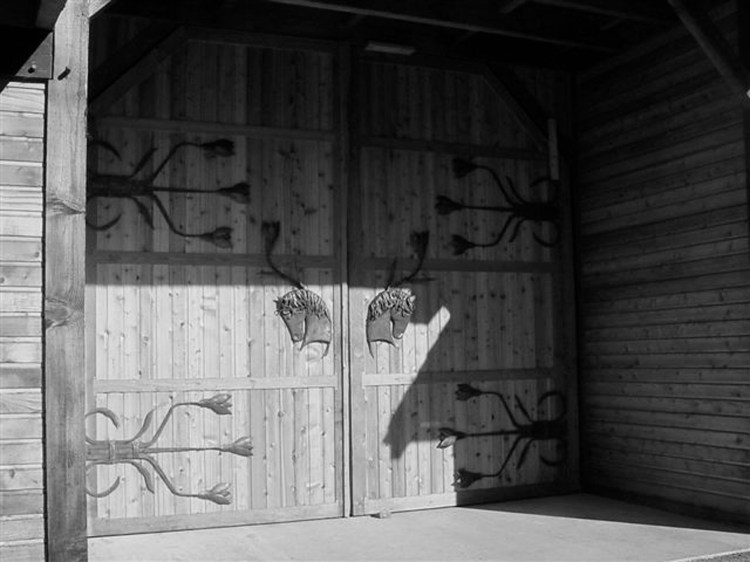
Coyote Ridge front doors. Metalwork designed by Perry Kalkowski of Lorane
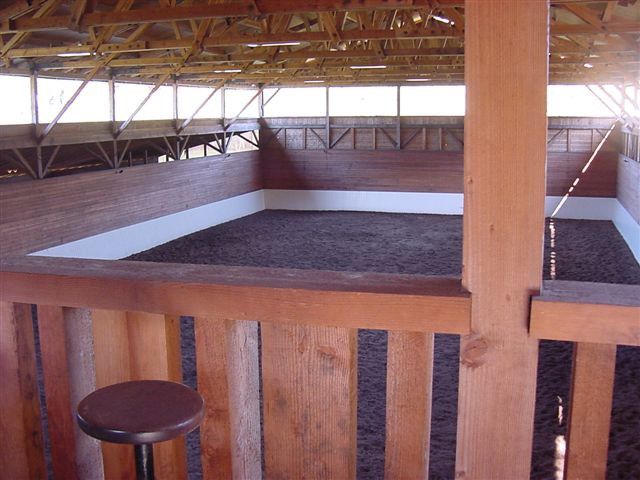
Upstairs viewing area
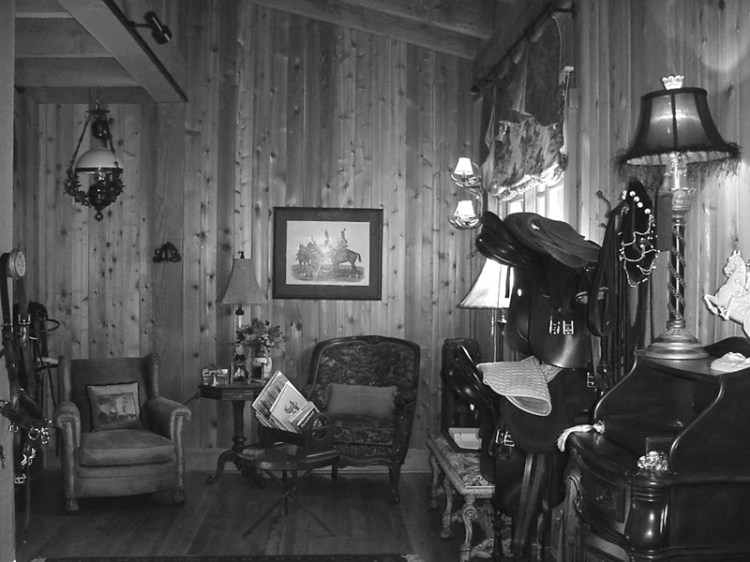
Coyote Ridge Dressage tack room
The tulip has become the Weiss’ logo. A Lipizzan horse is lovingly known as a “Lip.” The Weiss’ have imported two very special Lipizzan stallions from Austria to form the nucleus of their business… thus was born the secondary name for their farm, “2Lip Stud.” The whole building is immaculate and furnished like a warm European mansion with soothing classical music piped into every area. Downstairs, there are beautiful clean stalls for the horses, a grooming area, a wash area, a beautifully designed brick water closet used to hang freshly laundered horse sheets until they are dry, a large area for feed and equipment storage, a kitchen, bathroom and shower. Upstairs is the viewing area overlooking the arena. It has a row of vintage cushioned theater seats, each outfitted with an electric blanket for cold weather. The upstairs also houses a bar, an outside patio overlooking the outdoor arena and Tracey’s office. There are windows on all sides. From Tracey’s office, she is able to observe the horse stalls, the indoor and outdoor arenas and the pastures surrounding the building. The footing in the arena is as it was when Karl was at the Spanish Riding School, a combination of sand and cedar shavings. The dimensions are 20 x 40 meters in size as is the School’s. The walls are 12 feet in height to protect the horse and rider from exposed beams and to prevent a frightened horse from trying to jump or crawl over it. It also serves as a barrier so the horse and rider can work without outside distractions. Every 10 meters along the walls are symbols that are used to determine the precise distances and details used in the classical dressage training and conditioning techniques. Longing and conditioning are major parts of the training process to keep muscles supple and the horses free from injury when performing the intricate moves that are done by the more advanced horses. The outdoor arena is Olympic size (20 x 60 meters) and is marked with the dressage letters you see in the competition arenas. In good weather, the horses are worked in the special blend of concrete sand and shredded rubber. Both arenas are kept harrowed and during the dry season, the outdoor arena is watered daily to give the horses the maximum foundation for their footing.
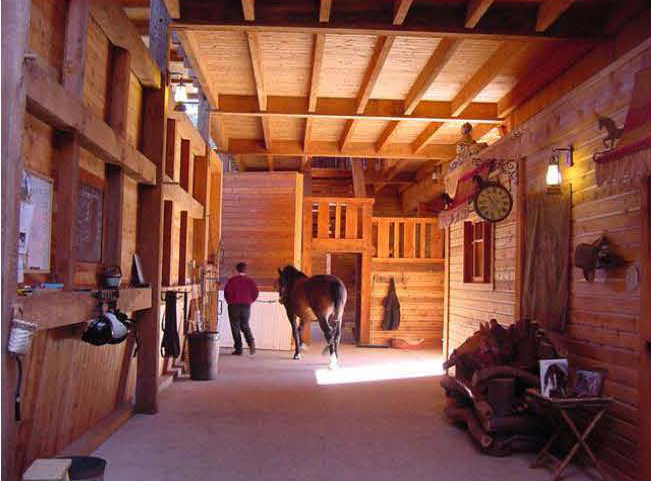
Inside of barn
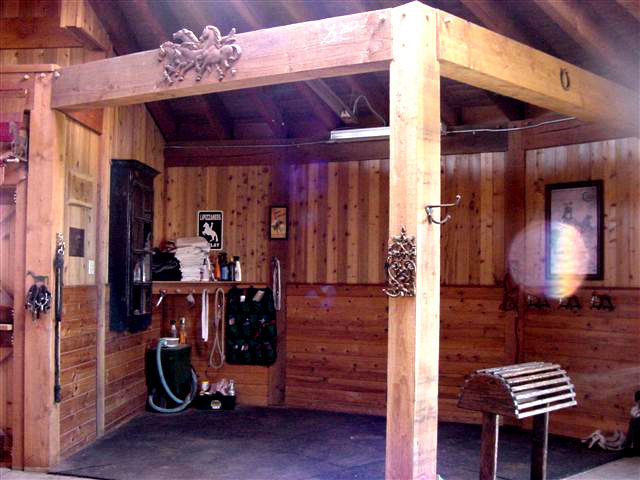
Wash area where the horses get their baths
Lipizzan stallions born in Austria all have a special brand of identification that is centuries old. These brands identify their lineage. An “L” on their left cheek shows that they were born in Austria, and signifies the original stud of Lipizza. A letter designation on their left wither identifies which of the 6 stallion lines their sire descended from and another mark below it tells of the maternal line. A number on their right side shows their birth number for that particular year. All Austrian Lipizzan stallions are given two names. The first is the stallion line they descend from. The second is the dam or mother’s name which, in Austria, must end in the letter “a” and be a feminine name. They are called by their mother’s names. The stallions and mares that Tracey and Greg brought to the United States are some of the finest on this side of the Atlantic. Maestoso Contessa 58 is a pure white stallion who is starting the highest level of training, called the Airs Above the Ground. This level incorporates amazing moves originally designed for use by the ancient warhorses and can only be achieved by extensive training and conditioning.
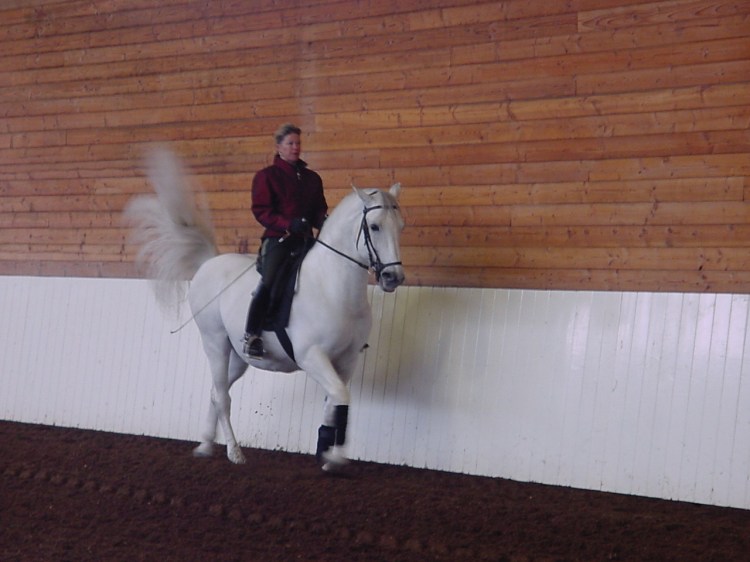
Tracey on Contessa on rail


From his name, it can be determined that Contessa is from the Maestoso stallion line, his mother’s name is Contessa, and he was number 58 in the order of birth. Tracey’s second stallion, Pluto Tücsök 44, is out of a Hungarian born Lipizzan mare, Tücsök, whose name doesn’t end in the traditional “a” because Hungary does not have the same rules. He bears the less common dark color that will never turn white. All Lipizzans are born dark but most begin to turn grey shortly after they are born. The breed once was represented by almost all colors found in other breeds ‒ chestnut, bay, black, even pinto ‒ but the greys or whites were favored by the royalty and the practice of breeding only white stallions to white mares has been strictly followed for centuries. Genetics, however, dictates that occasionally a dark colored horse that stays dark will be born. These were once frowned upon, but are now likely to become more and more in demand as breeding stock to get a dark gene back into the breed. Studies have found that melanomas occur much more frequently in light colored pigments in horses.
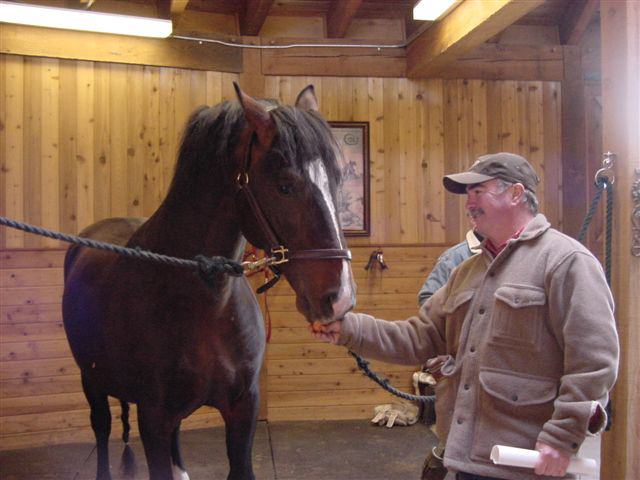
Greg Weiss and Tücsök “Pluto”
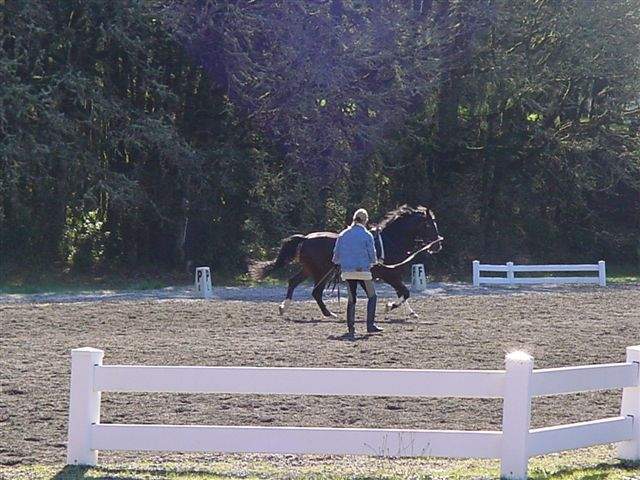
Tracey and Tücsök
In the past year, the Weiss’ have been harvesting semen from Contessa and Tücsök to be used for artificial insemination. The frozen semen is shipped all over the United States.
The Weiss’ also have imported from Austria two young Lip mares, Riga and Granada, who have just begun dressage training. Riga is grey/white and Granada is a bay who will remain dark. If Granada is bred to Tücsök, the foal will definitely remain dark. If Riga is bred to the bay stallion, her foal will be a surprise package, depending on the genes that she carries. Tracey and Greg also own other dressage horses and are training horses for other people, including two Lipizzans.
Tracey rides and works with each horse for about an hour a day 5 days a week. She is at the barn 7 days a week, 12 hours a day and studies for 2-3 hours a day. Karl Mikolka flies in from his home in Boston 5 to 6 times a year to work with her and to conduct clinics. He stays in a specially-furnished guest room on the farm during his visits. In addition to the clinics, Tracey and Greg host benefits and fundraisers for such recipients as Oregon State University School of Veterinary and other horse-related projects.
Tracey’s dream is materializing. She’s learning a lifetime of skills and knowledge that few other individuals have been able to attain or grasp from a master who has achieved them from his own intense study and practice. In Tracey’s own words, “My Karma is to pass this on to at least one other person in my lifetime.” She is that one person in Karl’s lifetime. It will be interesting to see who the next in succession will be.
Written in 2006 for From Sawdust and Cider to Wine
 All Things Lorane