Category: Writings

I have written all of my life and this collection will be diverse in content and genre.

My Time at Linfield College

by Pat Edwards

While a senior at Lebanon Union High School in Lebanon, Oregon, I, with my two friends, Bev Williamson and Jan Parsons, became obsessed with the idea of attending Linfield College in “far-away” McMinnville, Oregon. We, at first, thought that Oregon State College would be our choice for higher education. We paid a weekend visit to OSC and found it BIG. There were lots of students, lots of campus and lots of just about everything and it was a bit daunting for three rather immature small town girls. One thing that we did learn, too, was that making college visitations also allowed us to skip classes at school. We had “senioritis” and any excuse to adventure out on our own was fun.

So, after looking through other possibilities, Linfield, appealed to us. It was much smaller than OSC; the pictures of the campus in the brochures were gorgeous and it was only a two-hour-or-so drive from home. We signed up for a campus visitation, staying the night in one of the dorms and going to a dance.

Dances usually… always… meant ‘BOYS,’ too. Just as we frequently did at our own high school dances, we tried huddling in the corner to watch, but miraculously, we were actually asked to dance! These many years later, I wonder if, even though we were new faces at the dance, the campus gentlemen had been encouraged to show the newbies a good time. Regardless, we loved it, and at the end of the evening, we each had the name of our most frequent dancing partners held close to our hearts. Mine was Chuck Mahaffy. I believe that he was from Coos Bay and was a freshman at Linfield that year.

We returned home and began working on our parents to allow us to attend Linfield. The three of us girls made one or two more treks up to McMinnville, going through Albany and making our way north to Salem and west to McMinnville on Highway 99W to visit Linfield and attend a couple more dances there. For the rest of the school year, it was all that we could talk about. It had become our dream.

My parents, although not prepared to cover the more expensive tuition at Linfield, told their spoiled child that if she was able to find a summer job and obtain work-study funds, that she – meaning me – could try it for one year. Unfortunately, Bev and Jan’s focus changed to thoughts of marriage to the local guys they had been seeing, so the dream became mine, alone.

In early September 1960, my parents and I loaded the family car with suitcases full of clothes, shampoo, toothpaste and other necessities including my assortment of the tortuous brush hair rollers and bobby pins. I had boxes of typing paper, notebooks, pens and pencils, and occupying a special place in the car was my graduation gift… a brand-new portable typewriter in its sturdy silver-colored case and a supply of typewriter ribbons and erasers. It was an exciting time as my parents drove me over that now-familiar route to McMinnville.

After registering – probably at Riley Hall, the campus student center – we were directed to my new lodging – Campbell Hall. It was a pretty, three-story brick building with white trim that faced – or was more like, catercorner to – the oldest building on campus, Pioneer Hall. Pioneer has the white spire on top of it, reaching for the sky. My roommate was a shy young girl from the Portland area named Karen Thune.

My parents left for their return trip home and I began to settle in to our second-floor room. Karen and I immediately met two girls across the hall from us. Connie Michael, whose family farm was nearby in Dayton, and Helen McManimie, who was also from Dayton. The four of us eventually became close friends and to this day, Connie (who is now Connie Ruhlman) and I are best friends despite the fact that she has lived in South Dakota, Wyoming and Montana for the past several decades.

In 1960, Campbell Hall was an all-girls’ dorm and Pioneer Hall was an all-boys’ dorm. There were no coed dorms at that time… it would have been unheard of! We had a room-mother who locked the door at 10:00 p.m. sharp each night and if you weren’t in by that time, there were serious repercussions. There was a pay phone on each floor if we needed to make a phone call, so we had to have a bunch of dimes and other change on hand to use them.

After signing up for my classes, I went to Dillin Hall, the beautiful brand new ‘commons’ where meals were served, to interview for a work-study job. I was hired to do secretarial work for the manager, but there was never a set schedule or duties and my boss was seldom in her office, so I frequently just ‘hungout’ until someone gave me a job to do.

To earn a little extra cash, Connie and I put out the word that we would take in ironing. Chuck Mahaffy immediately assigned me his starched white shirts to iron at some atrociously low price per shirt. I probably charged 25 to 50 cents a shirt, but at this late-date, I don’t remember exactly how much it was.

In those days, we wore casual-but-nice clothes to classes and around the dorm, but on Sundays, we were to dress up in our Sunday best… thus the starched white shirts for the boys, and dresses and high heels for the girls.

Unfortunately, I was a good worker in the bean and strawberry fields at home, but I wasn’t domestic in any way. Ironing was not my forte, so my extra income from ironing soon dried up. I don’t think Connie lasted much longer than I did.

I didn’t see Chuck much after that and dated only occasionally. My attention had been redirected to a senior star football player that year by the name of Jim Clifton, but though very nice, his was just a friend. Dating anyone was secondary and all but non-existent. My friendships with Connie, Helen and Karen, however, were constants.

As I mentioned, we had to dress-up on Sunday mornings to attend chapel and at noon, to have a scrumptious sit-down fried chicken dinner at the commons. I vividly remember hurrying down the stairs at Campbell one Sunday morning in my 2″ spiked heels. One of my heels caught on the metal trim on a stair-step and I went crashing down the stairs head-first, putting a dent in my shin that kept me in the campus infirmary for several days with my leg elevated. I can still feel that dent when I run my hand over my right shin-bone.

In the strange workings of campus life – at least in 1960 – alliances seem to be formed between certain girls’ and boys’ dorms. Campbell Hall’s alliance was with Pioneer Hall. We seemed to have more activities and friendships with the guys in Pioneer than with any of the other boys’ dorms. One of those activities, however, caused a bit of ruckus on campus and, unfortunately, I was involved. I don’t know who the instigators were, but a challenge was issued. Secret plans were made between the two dorms to meet one night after dark for a water-fight. Preparations began in earnest. Some of the girls had a bunch of balloons which we began filling with water. Others armed themselves with squirt guns and pitchers and jugs of water. Anything that would hold water was filled and readied for the fight. The site was to be outside Pioneer Hall, I believe. Once in position, water balloons and streams of water were flying everywhere and we were all soon soaked. I then noticed that someone nearby had hooked up a water hose to an outside faucet and I ran over to help hold on to it. We were hosing everyone down and soon there were only a few people left and I found myself holding the streaming hose all by myself. When I looked around to see where everyone had gone, I looked right into the eyes of Dr. John Boling, the Dean of Men, as someone else turned off the faucet. Embarrassing? Oh yes!

We girls were all marched back to Campbell. We were dripping-wet and left wet footprints wherever we went. After a stern lecture about how something like this was to never happen again and threats of what would happen if it did, we marched up to our rooms to change into dry clothes and spent the rest of the evening mopping up the puddles that we had left on the floors and stairs.

Even though it may not sound like it, college was not all fun and games. I drowsed through World History lectures, and awakened and enjoyed my Appreciation of Music and Art classes. Even though I wasn’t particularly religious at the time, I absolutely loved the required “Life of Jesus” classes, comparing the gospels and taught by Dr. Paul Little. He brought the story of Christ to life for me. Even then, I loved to write, so I looked forward to the compositions that I was assigned to write on my trusty little portable typewriter. I went through quite a few typewriter erasers that year, if I remember correctly.

Oh, how I loved college life! But, towards the end of the year, when my friends were making plans for their sophomore year, my parents informed me that there was no money left for another year’s tuition. It was with a heavy heart that I said my good-byes and left Linfield for the last time. I only spent one year there, but I made lasting friendships and special memories that have continued throughout my 71 years of life.

Included in OREGON’S MAIN STREET: U.S. Highway 99 “The Stories” by Jo-Brew (2014)
 

In Memory of Estelle Counts

By Pat Edwards

Stell & Lloyd Counts

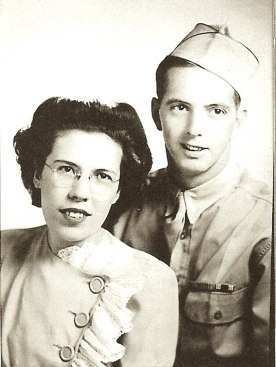
Stell and Lloyd Counts on their wedding day

It never occurred to me that Stell Counts would ever die. Knowing Stell – loving Stell – I just assumed that she would always be there. She emitted such feisty energy, such excitement for new things, and such love for her family and community, that I could not imagine her any other way. And, you know what? I believe that I was right! Stell may have left her body, but in her heaven, she is still with us.

I am currently reading a book called The Lovely Bones about a 14-year old girl who narrates the story as she looks down from heaven after her premature death. In the book, she describes her heaven as being anything she wants it to be… that heaven is different for each person. The girl chooses to spend her time in heaven observing her family and friends and the manner in which they deal with her death. For Stell, I know her heaven is similar, for I don’t think she would have wanted to live anywhere else in any other way than she actually did, and the people in her family and community will always remain the most important to her.

Jim and I feel an especially deep loss – the loss of not being able to see that wonderful lady coming into the store or attending a school function. She has had such a profound impact on our lives over the past 30 years that we will continue to look for her each day. Even though we made some drastic changes when we converted the Mitchell Store into the Lorane Family Store, she was always a vocal supporter. When Jim said that he was going to have to tear down the old store (which was gradually falling into the creek) and build a new store, her excitement and encouragement accompanied him every step of the way. When friends and acquaintances would reminisce about the old store and how differently it was “back then”, she would admonish them that “Jim has his own way of doing things and is doing a wonderful job!” When the family sold the family homes across from the store and the buyer defaulted, she would not hear of putting them back on the market. She wanted Jim to buy them and despite my hesitancy to take on rentals, she insisted that no one but Jim should have them. Between the two of them, I was railroaded into signing the contract even though I kicked and screamed all of the way.

When Nancy, Marna, and I conceived of writing the history of the Lorane area, it was Stell and Lloyd that we turned to. They knew all of the “old timers” and it was their shared confidence in us that allowed us to pre-sell enough of our books to pay for the first printing. Stell dug deep into her memory and her treasure trove of pictures and supplied us with information and leads to track down the early families of the area. When we found pictures in which people were not identified, Stell took on the project of finding out who they were. When we began planning the 1987 Lorane Centennial celebration, Stell and Lloyd were active participants and the excitement that she generated kept us all on track and helped to keep at bay any discouragement we felt in the huge task of planning.

In recent years, as her health began to fail and she was no longer able to drive, she spent more time at home, but that didn’t stop her from continuing to impact the lives of those around her. Kids, including our own grandkids, from the Lorane Elementary School, frequently stopped by her house to visit with Stell on their way home from school. She always had a cookie or a snack for them and they loved to sit with her and visit for awhile before continuing on home. She was ageless to them and helped to bridge the proverbial gap between youth and the elderly that many of us fail to even attempt.
If Lorane was a bigger community, we would be naming a building or a special project after her… “The Estelle Counts Community Center” or “The Estelle Counts Memorial.” But, we are a small community and since most of us here knew and loved her, our memorial to her should be to not let her energy or love of community die. If each one of us vows to get involved in preserving the links between the past, present, and the future of Lorane, it will evolve, as Stell would have wanted, but it will also remain a community where we can all feel we belong. And, for each positive involvement, you can be sure that Stell will be smiling from her heaven.

So, if you’re watching us now, Stell, God Bless You! You did it your way, and that’s the most any of us can ever hope for!

Estelle Mitchell Counts (1918-2002)

Saying Goodbye to Jimmy: Jim Burnett, Sr. (1937-2018)

By Pat Edwards

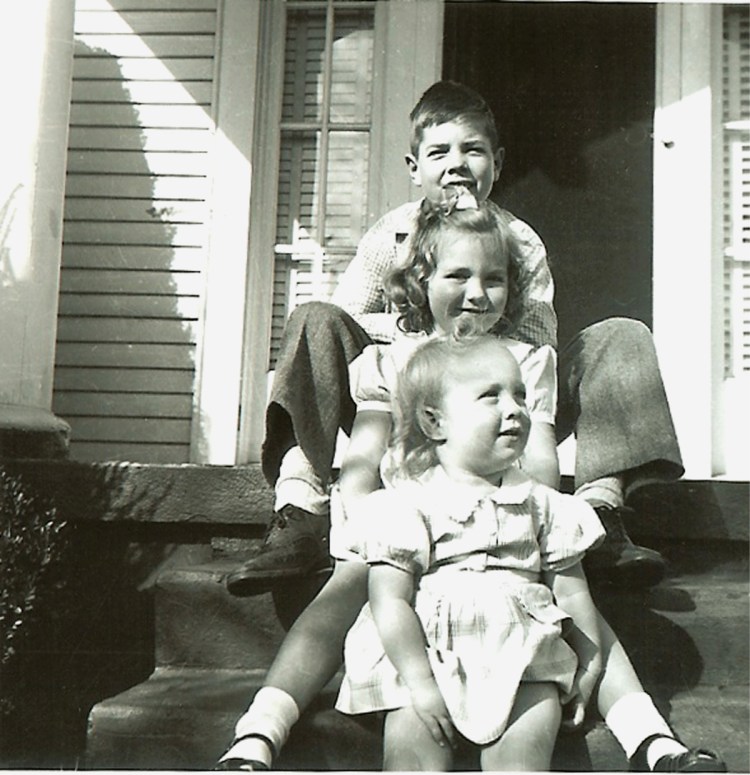
By the time I was born, Jimmy was 5 years old; in fact, the three of us siblings were each separated by 5 years. I was 5 years old when our sister, Barbara Jean, was born. (I call her B.J.) By the age of 5 years, Jimmy was busy playing with his cousin, Bob, and his other friends, so we were never close as kids. It seems that the older he got, the less we had in common with each other. So, my childhood memories of him are pretty minimal, sparse and scattered.

3 Stairsteps.jpg

Stairsteps: Jimmy, Patty and Barbara Jean

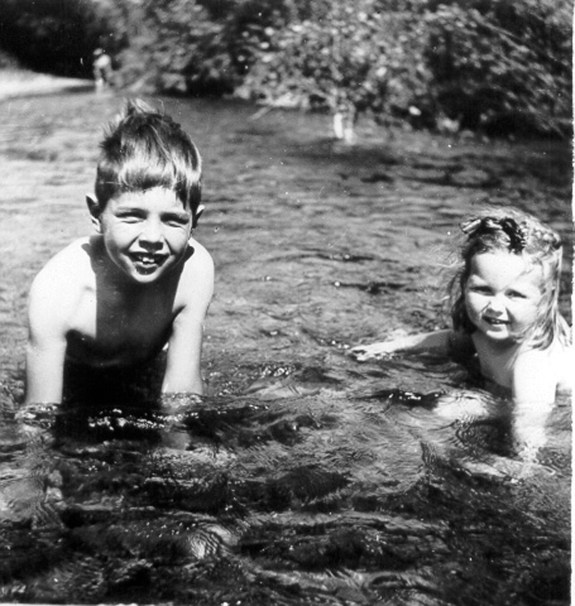
jimmy&patty

Jimmy and Patty

I do know, though, that his childhood was difficult. B.J.’s and my father—Jimmy’s stepfather—doted on us girls, but he never fully accepted Jimmy as his son. My mother tried to bridge the gap, and Jimmy was always included in all of the family activities—sledding in the snow, fishing and camping at Clear Lake, going to the car races in Salem, vacations to see family in Los Angeles—but when home with family, he became more and more of a loner, the older he got. By the time we moved to Airport Road in Lebanon, he was a teenager and when he was not in school, he spent hours during the summer months up in his favorite apple tree in the backyard where he had built a fort in its branches, sitting, reading, and eating Gravenstein apples. When B.J. or I wanted an apple, we asked him and he lowered a couple down by the bucket on a rope that he used as a dumbwaiter. During the rest of the year, he spent his time in his bedroom above the garage, away from the rest of the family, lying across his bed, reading, and instead of apples, he ate oranges. He loved fruit! Mama found the evidence—orange peelings—under the bed when she went to clean his room. For the most part, my memories of those times picture him as serious and sometimes angry.

I can remember that during his senior year, he was on the football team at Lebanon Union High School. During one game, he was tackled and hit his head, resulting in a concussion. That ended his football “career.”

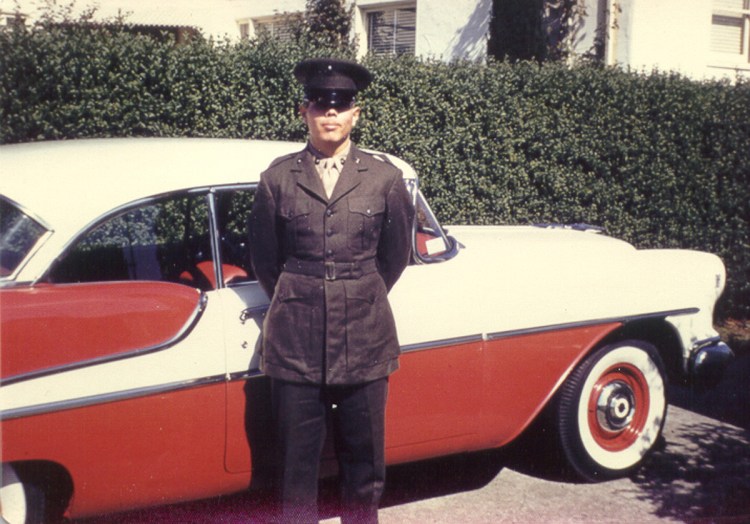
It was that same fall that Daddy sold his International Harvester dealership in Lebanon, and we put our house on the market. I was halfway through my 6th grade year of school and Jimmy was in his senior year. Because my mother didn’t want to take him out of school for his last year, she arranged for him to live with friends until he graduated. The rest of us—our parents, B.J. and I—then moved to Phoenix, Arizona for the next 6 months where we finished our schooling for the year. When school was out, we then moved to Eureka, California where Jimmy stayed with us for a short while before he joined the U.S. Marines.


marine-olds

I didn’t know how traumatized Jimmy was by our move to Phoenix until visiting with him the week before he died. He revealed to us for the first time that he felt abandoned and very much unloved when we left Lebanon without him. The disclosure about broke my heart because when he told B.J. and me, the pain was evident in his eyes and his tears flowed.

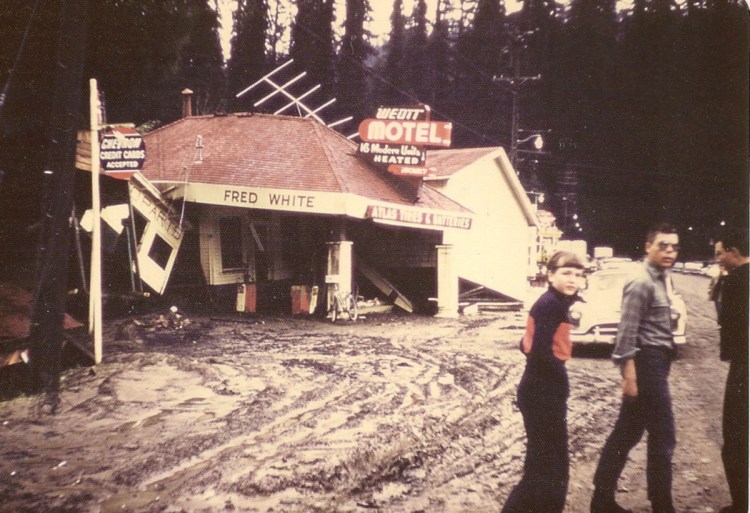
Joining the Marines was not a good fit for our brother. It was too structured and too demanding for the free spirit he was becoming. When he and his good friend, Curt, visited us on “leave” for several days while we were still in Eureka, the little teeny-bopper that was me developed a big crush on Curt who, I am sure, must have squirmed every time I gave him a flirty smile. I remember the visit well. They arrived a day or two after the neighboring town of Fortuna and Humboldt County suffered a major flood in December 1955. We have photographs of us exploring the damage—washed out bridges and buildings.

California flood Jim Patty Curt

We learned later that when he and Curt returned from their visit, they faced AWOL charges and disciplinary measures. (I’m not telling tales out of school. Jimmy never kept it a secret—in fact, I listened as he told the whole story to one of his friends who visited him that last week before his passing.)

After he left the Marines, I only remember occasional visits from him. The one notable one was after Mama, Daddy, B.J. and I moved back to Lebanon. We bought a strawberry and bean farm on Brewster Road. One day, Jimmy arrived, accompanied by a pretty young lady named Betty Lou Branchflower. He was living in Portland at the time, and so was she. They had just gotten engaged and he wanted to introduce her to the family. She was a city girl and wasn’t sure about the farm life we led, but B.J. and I got out our horses, Rocket and Rocky, and gave them rides around the farm.

During the next several years, they got a good start on their family—first J.R., who was born the day before my birthday; then Curt and Greg. Betty Lou would send us some of her favorite recipes in their Christmas cards. I still have several of those handwritten recipes that Mama always kept in her metal recipe box.

Whole family

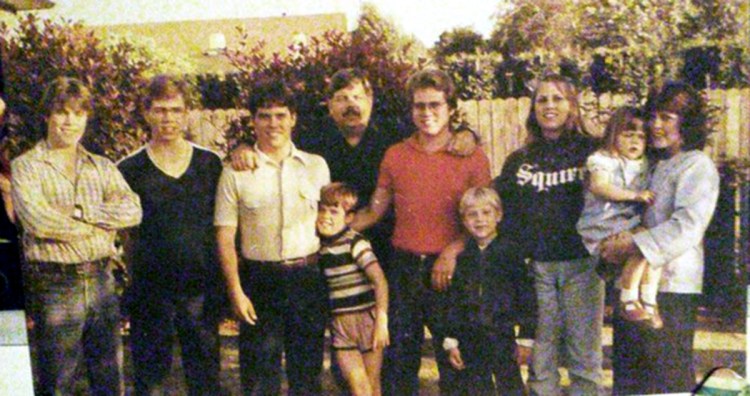
Curt, Paul, Greg, Jimmy with Joseph in front, J.R., John, Ginger, Betty Lou with Erin

They would bring the boys to see us about once or twice a year. The visits became less and less frequent as time went on, though, and we all but lost track of them. We pretty-much missed out on most of Joseph’s, Ginger’s, John’s and Erin’s childhoods, I’m afraid.
Sometime, during those years, Betty Lou asked us to begin calling her Heather. She decided to change her name and I respected her wish as I could, but she has always been “Betty Lou” in my heart to this day.

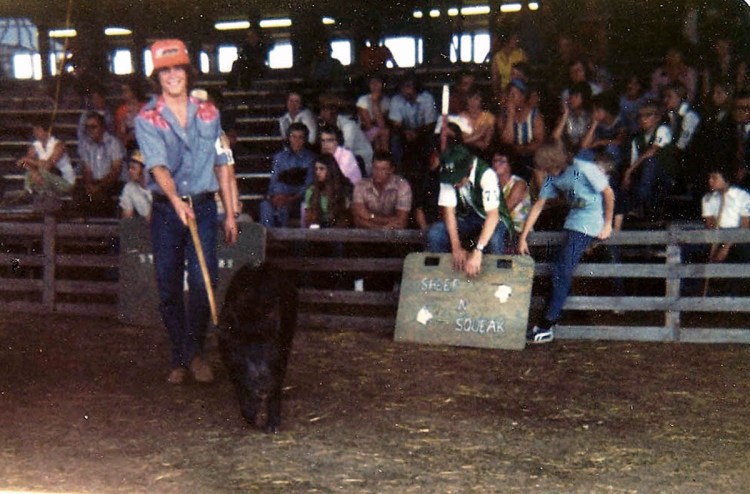
Later on, after Jim and I were married and living on our farm near Lorane, Curt and Greg came to stay with us. Curt was with us through some of his freshman year of high school and the following summer. During that time, he joined our kids’ 4-H group, raised a hog and showed it in the Lane County 4-H Fair. Greg joined him that summer and they both worked through haying season on our family’s hay crew—bucking hay, building muscles as well as character. I feel so blessed to have been able to spend that time with them.

Curt in 4-H3

Curt showing his hog at the Lane County 4-H Fair

After that, we only got together sporadically. They would frequently come down to attend our major family celebrations. I remember one get-together at our place when Joseph put on a skateboard demonstration for us out in the middle of Lorane Highway while some of us spotted the traffic for him.

It was several years later when email opened up new worlds to all of us. Much later, it became the means where Jimmy and I reconnected on a very meaningful period of our lives. By that time, Paul had come into our lives; Jimmy and Heather had divorced, and I lost track of him for several years. I found out later that he had traveled some pretty rocky roads during that time, but eventually he met Jonni and she became his ballast… his salvation.

We began chatting back and forth on email and reconnected. I was working at the University of Oregon at the time and he became interested in the work I was doing there with a group of neuroscientists. It was obvious how well-read he was… all of that reading he had done in that apple tree had borne fruit. His love of books led to a love of learning, of broadening his intellect and writing it down on paper and through emails. I knew that he had become interested in our Grandma “Zander” (Alexander)’s Unity faith and in learning more about it, he began forming his own faith and philosophy of life.

It’s my belief that he turned in this direction because he realized that he still retained a lot of anger from his childhood. I never knew that anger to ever come out physically. He bore most of it inside, known only to him. He turned to books and learning instead, I believe, to understand how to deal with it.

Jim 2

I didn’t understand a lot of what he wrote to me in those days. He was intellectually on a much higher plane than me as far as critical thinking was concerned. But, although we didn’t connect in that way, I did begin to feel I was finally getting to know my big brother on a personal level. There was a kindness that had always been there in adulthood, but it had blossomed into a gentleness and deep compassion for mankind. I admired and respected the work he did for his church and his faith.

When I became involved with the publishing of Groundwaters, a quarterly literary journal, after my retirement in 2004, I sent Jimmy some copies and he became excited about the possibilities it presented to local writers and poets. When the owner of Groundwaters decided to shut it down because of health issues, I mentioned to Jimmy that I and two others were wanting to take it over and keep it going. He immediately asked if he could be a part of it, as well. We welcomed his expertise in guiding us through the process of setting up a business model and later, the steps we needed to operate as a non-profit under the 501(c)3 umbrella that we were offered. He became our business manager. Later, he began submitting his own stories and essays for publication and soon proposed to write a column for each issue called the “Philosopher’s Corner” under the pen name of “Jimminy Cricket.” Our readers loved it. It was simple and non-judgmental. It offered a view of life as he saw it in a gentle, sweet way.

Jim_color

We and our two partners worked closely together on producing each issue—editing, critiquing and proofing them—until he developed the brain tumor that required surgery. After that, while it was healing, he was not able to formulate his thoughts well enough to put them on paper, but, he never lost his interest in the magazine. It had brought us close together and we cherished the chance we had been afforded to spend those precious years in getting to know each other.

I miss my brother and always will. Our last two visits before he passed were special to me. It was a time when we were able to really open up to each other and express the love we had. I wished him Godspeed then and I know that he is now in a place where he can bask in all of the love that he truly deserves.

Published in the 2019 Groundwaters Anthology