Category: Published Books

The Baileys of Bailey Hill (2017)

By Pat Edwards

First in a series titled “Early Lane County, Oregon Families with Lorane Connections”

75 pages
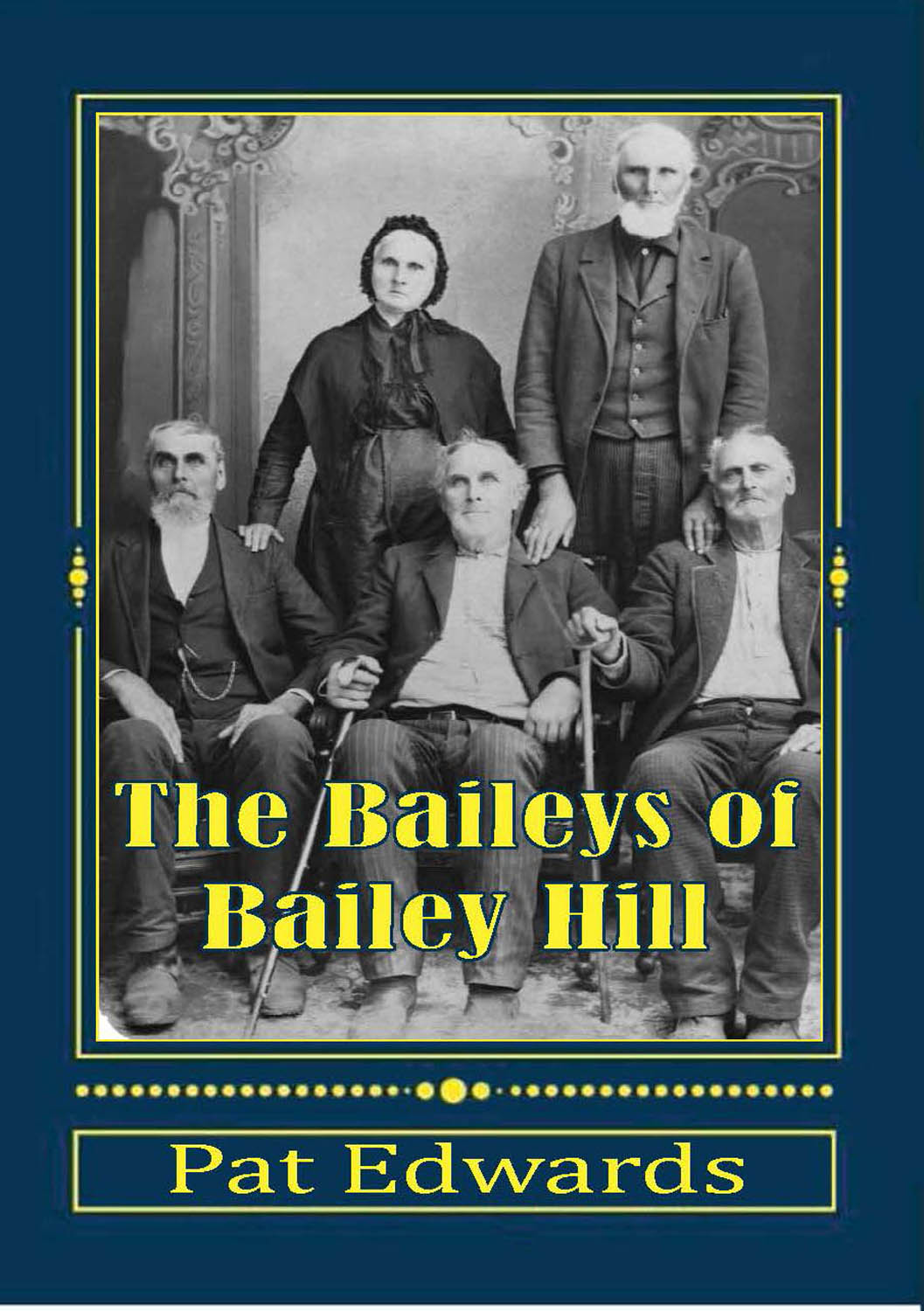
In researching the Bailey family of Bailey Hill, I became enamored with the strength of character and thread of family bonding that ran through their midst. When I began my project, it was with the intention of profiling 4-6 families in one book, but once I got into my detailed research, I knew that there was much more to the family than I expected.

The history of the Bailey family of Bailey Hill has proven to be rich and interesting. Arriving in the late 1840s and through the 1850s, they were early pioneers to Benton and Lane Counties in Oregon and, although their major connection was not with the Lorane area, they had a strong presence in the Siuslaw Valley and other parts of Lane County, Oregon as well.

Bailey Hill, the area where several family members settled that eventually took on their name, lies southwest of what was then Eugene City. In the 1850s, it was described as being 5 or 6 miles from Eugene City. Today, there really is a Bailey Hill, and Bailey Hill Road runs north and south, over the top of the hill, where it later connects with Lorane Highway to the south and West 11th to the north.

There used to be a Bailey Hill School District #7 and the Bailey Hill Elementary School building still stands today on the corner of Bailey Hill Road and Four Oaks Grange Road, but it is no longer used as a school. The land it sits on was donated by Bailey family members and is still owned by the Eugene School District #4. It’s very possible that the adjoining property where Churchill High School is located was part of their property, too, although it came much later.

Several of the Bailey family members came through Oregon on their way to the gold fields of California. The gold that one brother found in turn helped to finance the family’s movement across the plains from Missouri.

According to Harry Bailey’s obituary, published on November 6, 1929, when his grandfather, John Bailey, Jr., arrived in Lane County, “the Skinner cabin was the only building here.”

Several brothers volunteered to serve in the Rogue River Indian Wars that took place in Jackson, Josephine and Douglas Counties to our south from 1855-1856. In the aftermath of the war, in skirmishes with the tribes, two of the brothers lost their lives and one was wounded in separate incidents.

The family also had a strong presence besides just a strength of character. A unique family characteristic they shared tended to call attention to them whenever they were in a group, especially. John and Sally’s adult children were extraordinarily tall for their generation. The shortest of the siblings was Elizabeth, standing at 6’ in height. The sons ranged from 6’ 2” to 6’ 71/2”.

$12.00 plus shipping
Order Here

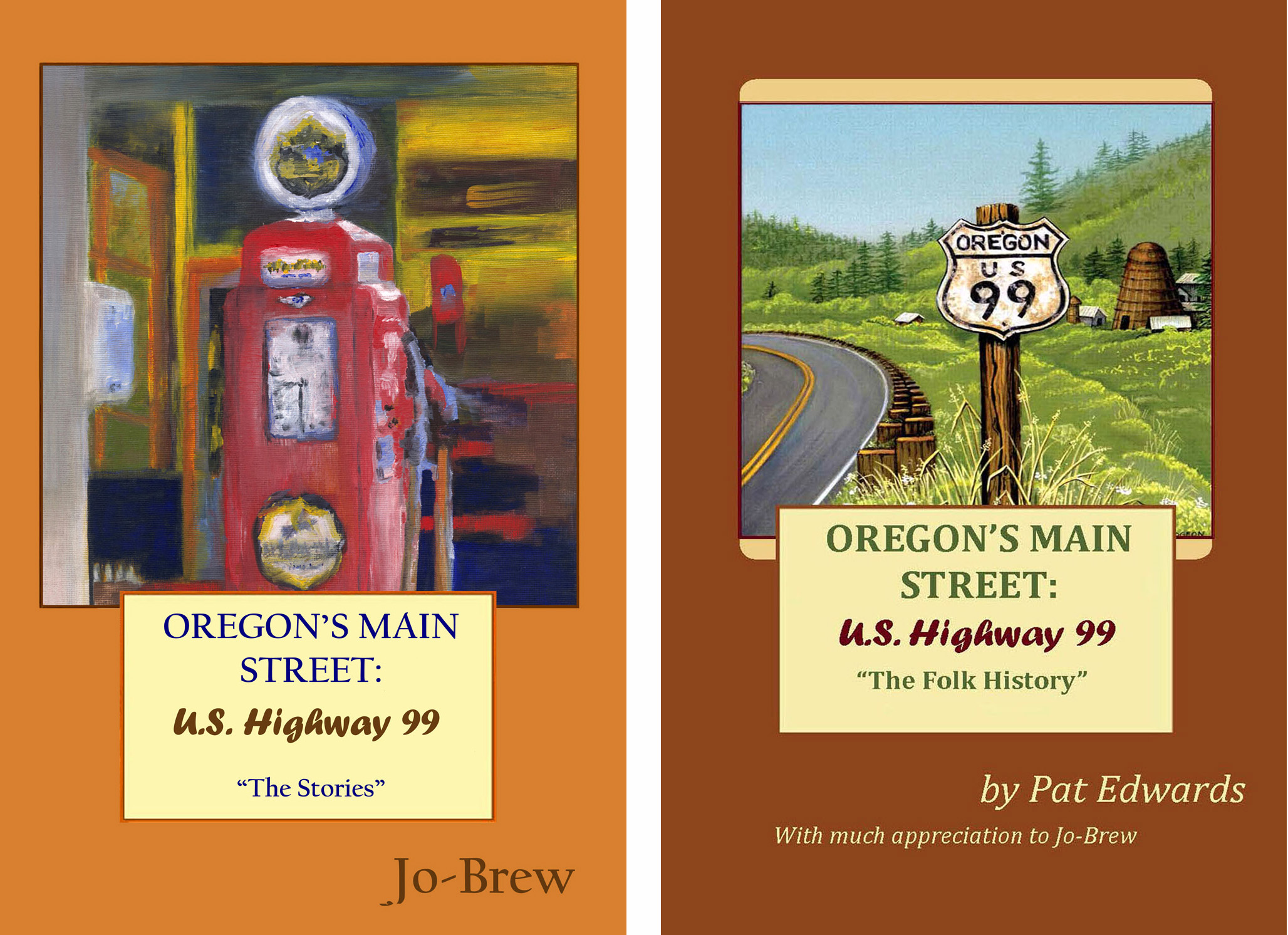
Set of 2 books – OREGON’S MAIN STREET: U.S. Highway 99

By Jo-Brew and Pat Edwards

“The Stories”

Long before Interstate 5 was built, Pacific Highway, later designated U.S. Highway 99, became our “Main Street” not only through the State of Oregon, but from Mexico to Canada. Unlike I-5, U.S. Highway 99 went through towns and small communities along its path, bringing them the means to connect with the rest of the state and nation. Jo-Brew takes us on a trip, south to north, beginning at the California-Oregon border, as the highway continues its climb through the Siskiyou Mountains. We then go down through the connected valleys where economies were built on orchards, forests, farm lands, recreation and businesses built to support the growing reliance on the automobile and commercial truck traffic that used it daily to deliver people and products to their destinations. OREGON’S MAIN STREET: U.S. Highway 99 “The Stories” takes us along this route today, but it is filled with the stories of those who grew up, worked, played and raised their families in the communities along its path. Over 150 individuals shared their stories, some in the form of old letters and diaries, but most in first-person accounts through interviews, letters, email and even phone calls all done personally by Jo-Brew. We both worked together on researching, editing and laying out this and its companion book, “The Folk History.” She allowed me to co-author “The Folk History,” which contains more stories and insights into these same communities along the route of U.S. Highway 99 that connect with their earlier histories. Her interest were in gathering the stories from extensive interviews she did; mine was focused on the local and folk histories of the communities. For those who love old pictures, you will be treated to many more than we were able to include in “The Stories,” too — 422 photos and illustrations, in fact. Before her death on March 1, 2018, Jo turned over all rights to “The Folk History” to me. Proceeds of “The Stories” were generously bequeathed to the Lane Library League of Lane County, Oregon. So, climb on-board Jo’s little red Rambler and let’s take a ride up Oregon’s “Gut,” or — if you’re too young to remember driving “the Gut” in your own hometown — let’s take a drive on “Main Street, Oregon.”

~*~*~*~*~*~*~*~

“The Folk History”

In 1913, the first shovelful of dirt was turned by Oregon Governor Oswald West on the Siskiyou Pass to mark the beginning of the construction of the long-dreamed-of Pacific Highway through Oregon. At the time, the whole State of Oregon had only 25 miles of paved road. Even after construction of the highway had begun, it was mainly dirt and gravel for quite some time. Federal money did not pour into the project until 1921. Up to that time, it was up to the individual counties along the route to come up with the funding to build the roads through each of their areas. By its completion in 1926, however, it was adopted as U.S. Highway 99 and was declared the longest improved highway in the country by 1928. Actually, the history of the highway began long before 1913. This book covers how the route for the Pacific Highway was determined through its use by Native tribes and later by trappers, miners and settlers who used portions of the California and Applegate Trails in their journeys, and eventually by the stage lines and the railroad. It will also show how each of the settlements along its route were formed and grew into prospering cities, small rural communities and some that are now ghost towns. Join us on our journey through these communities as we wend our way north from the California border where the Pacific Highway first started from that shovelful of dirt. You’ll learn about some of the interesting, but lesser-known, aspects of their histories and the people who were instrumental in making them what they are today.

BOTH BOOKS – $34.00 plus $6.00 shipping

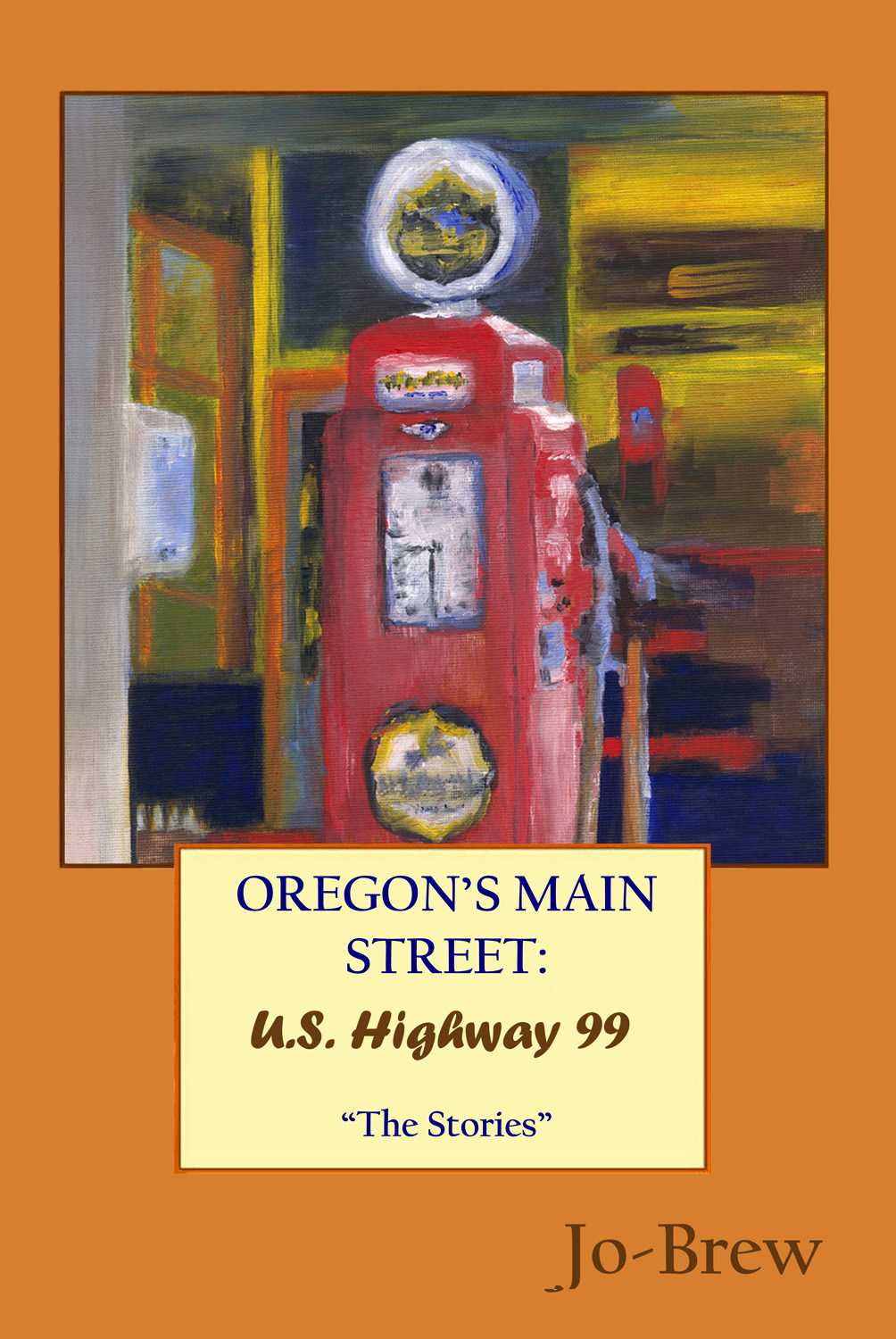
OREGON’S MAIN STREET: U.S. Highway 99 “The Stories” (2013)

By Jo-Brew (Pat Edwards, editor and collaborator)

360 pages

Long before Interstate 5 was built, Pacific Highway, later designated U.S. Highway 99, became our “Main Street” not only through the State of Oregon, but from Mexico to Canada. Unlike I-5, U.S. Highway 99 went through towns and small communities along its path, bringing them the means to connect with the rest of the state and nation. Jo-Brew takes us on a trip, south to north, beginning at the California-Oregon border, as the highway continues its climb through the Siskiyou Mountains. We then go down through the connected valleys where economies were built on orchards, forests, farm lands, recreation and businesses built to support the growing reliance on the automobile and commercial truck traffic that used it daily to deliver people and products to their destinations.

OREGON’S MAIN STREET: U.S. Highway 99 “The Stories” takes us along this route today, but it is filled with the stories of those who grew up, worked, played and raised their families in the communities along its path. Over 150 individuals shared their stories, some in the form of old letters and diaries, but most in first-person accounts through interviews, letters, email and even phone calls all done personally by Jo-Brew. We both worked together on researching, editing and laying out this and its companion book, “The Folk History.” She allowed me to co-author “The Folk History,” which contains more stories and insights into these same communities along the route of U.S. Highway 99 that connect with their earlier histories. Her interest were in gathering the stories from extensive interviews she did; mine was focused on the local and folk histories of the communities. For those who love old pictures, you will be treated to many more than we were able to include in “The Stories,” too — 422 photos and illustrations, in fact. Before her death on March 1, 2018, Jo turned over all rights to “The Folk History” to me. Proceeds of “The Stories” were generously bequeathed to the Lane Library League of Lane County, Oregon.

So, climb on-board Jo’s little red Rambler and let’s take a ride up Oregon’s “Gut,” or — if you’re too young to remember driving “the Gut” in your own hometown — let’s take a drive on “Main Street, Oregon.”

$17.00 plus $5.00 shipping