Author: paedwards

Eulogy for a Tomboy

By Pat Edwards

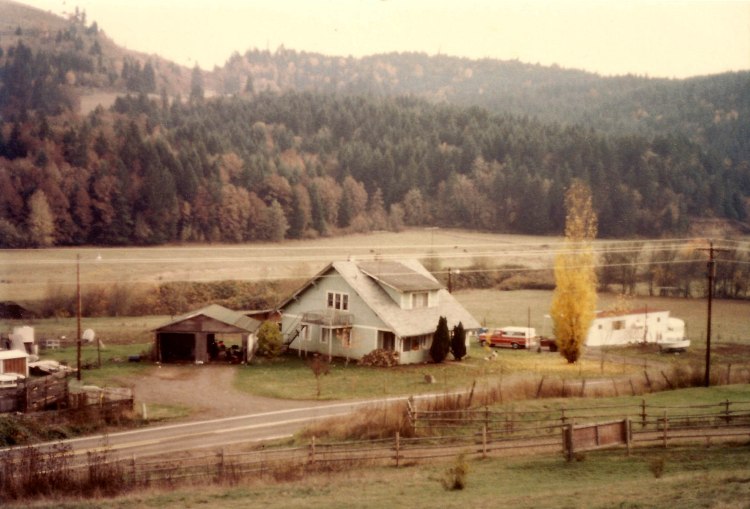
(Written in 1991 when Lane County proposed to tear down or move our home when the restructure of Lorane Highway was being planned… We won, by the way! The house now belongs to our daughter Michele and her husband Brian Kau where they raised their 3 girls, Stephanie, Linsey and Hayley)

No one knows how old she really is. A good guess would be 80 or 90 years. For the 25 years that Her family has known Her, She has been all tomboy ‒ definitely not the debutante sort. Her exterior is rather scruffy and pretty much devoid of makeup. But, there has always been a life and gaiety within Her. For the past 25 years She has embraced those who love Her ‒ sheltering them from not only Mother Nature’s storms, but the storms of life as well. Only recently has She begun to take on some adornments. There has been so little time until now.

Life around Her has never been dull. There were four children to raise into adulthood. Over the years, in addition to those kids and their parents, She has taken to Her bosom the cousin who was expelled from school for smoking marijuana; the foreign exchange student who spent a school year with them; the two huge football players from California who stayed with them while going to college; two teenage girls who needed a home; and a whole variety of friends who “spent the night.”

When They first came, those 26 years ago, They slapped a coat of paint on Her and got most of the trim done. They planted a couple of trees in the yards surrounding Her and tried to grow a few flowers. But in the early years, the care and feeding of four kids, tending the huge vegetable garden, doing the farm chores, canning in the summer, and many other activities left little time for helping Her to gain much charm or beauty. And then there was Brigitte, that beautiful, gentle St. Bernard, like Peter Pan’s Nana, who helped to take care of the kids and to keep the peace, but who also had no awareness of or respect for those few flowers and shrubs surrounding Her. Then there were the succession of 4-H animals ‒ steers, heifers, rabbits, and sheep ‒ who were brought into Her yards for their baths, grooming and training sessions, not to mention the ponies and horses that became members of the family. All contributed to Her tomboy appearance. But, oh, how much love permeated through Her and around Her!

The children are all grown now. The days of the hectic schedules of football, volleyball, and basketball games, track meets, gymnastic and music lessons, 4-H meetings and fairs, booster club meetings, school board meetings, P.T.C. and Parent Network meetings have passed.

It has only been in the past few years that They have been able to concentrate their efforts in making a swan out of the ugly duckling. She has been given a new exterior and awaits Her new coat of paint. Plans have been drawn for a new kitchen; new carpeting was planned. She has new windows and a new front door. Her yards have been fenced and manicured. The dandelions are almost gone. Best of all, She now has flower beds with blooms from early spring through the fall. Her trees have become graceful and provide cool shade in the summer. There is a peace and serenity about Her. She has done Her job well.

But, her time for grace is not to be. They have been informed that by next spring, Their beloved tomboy of a home will be gone. Modern life dictates that the ground on which She has rested for so long must be used for a bigger, wider highway. She cannot be moved. She would not be the same. The damage that would be caused to Her by a move would require life support measures to keep Her going. Though a tomboy, She still possesses a dignity ‒ one which would not allow the humiliation of standing on an island surrounded by asphalt, or being moved to a sight foreign to Her.

Because cars need to speed and bicycles need a safe place to be ridden, she must go ‒ and They must grieve.
The Home Place

A Quiet Joy

by Pat Edwards

Telephone solicitors had ruined so many pleasant evenings for me that it was with reluctance that I rose from my comfortable chair to answer the insistent ring of the phone. It was the year 1993 – before the days of caller I.D and “no call” lists. The woman on the other end began asking questions, and at first I thought that she had the wrong number – although she knew my name. I patiently answered all of her questions, but began to wonder why she needed to know things such as my maiden name and that of my mother.

The answer became suddenly clear when she finally said, “My late husband and I adopted a baby girl, whom we named Stacey, almost 30 years ago. She was born on August 7, 1963 in Emanuel Hospital. Does this mean anything to you?”

A kaleidoscope of emotions and memories, accumulated and tucked away for 30 years, descended upon me. I have read stories of other birth mothers being found by their children. They frequently described an immediate and profound joy. The mixture of emotions I felt included shock, anxiety, shame, relief and a guilt that there was no explosion of maternal bliss. And, in the days that followed, I still found myself sorting through that mixture to try and discover what my basic feelings really were.

From the moment that I hung up the phone after that call, I felt that I was being carried forward by a force that I could no longer control.

In 1993, Stacey lived in a neighboring state. Lee, her adoptive mother, had been helping her to search for me when she made that call. Lee excitedly said, “Can we meet for lunch tomorrow? I’m so anxious to meet you, and Stacey will be so excited when she finds out I found you!” I numbly agreed to our luncheon date, but could not reach for the phone to call Stacey. It was too soon.

When I told my husband Jim about the call, he was euphoric. Within a half hour of the phone conversation, he had called each of our four adult children to set up a family meeting. Our son, who lived out of town at the time, wouldn’t be able to come for two days. At work, during those two suspenseful days, my phone rang several times. “Mom, can’t you tell us what this is all about? You and Dad are scaring us!” I tried to reassure them that no calamity had befallen our family, but I could not ease their anxiety.

After talking to Lee that fateful night, I felt as though I was on a speeding train with the throttle stuck open. My nerves were rapidly reaching the breaking point. Everything within me wanted to scream out, “Whoa! Slow down! Give me some time to adjust!” I needed some “space” to sort through what I was feeling and thinking.

I could not call Stacey until I had talked with our other children. I was confident that they would take the news well, but I needed that reassurance. I was afraid – afraid that I might not be able to live up to what Stacey would expect of me as her birth mother; afraid that Jim would be disappointed in me because I was not as excited as he; afraid that our children would be ashamed of me. I wasn’t experiencing that profound joy that books and articles so often describe.

When the time for our family meeting finally arrived, I was more than ready to get everything out into the open. When I arrived home from work, everyone was either busily fixing dinner or watching the news on TV. Their nervous glances at one another was the only indication that we were there for something other than one of our frequent family get-togethers.

I called them into the living room and sat cross-legged on the floor in front of Jim’s big easy chair. Slowly and deliberately, Jim began to tell them of the sister that none of them had known they had.

Tearfully, I took over the narration. “Your father is not Stacey’s father. I met your Dad just weeks before I discovered that I was pregnant. He had just been discharged from the Army and had no job…” I told them about the circumstances of Stacey’s birth and how their father had stood by me during that most difficult time.

As Jim began to speak again, he broke into sobs. “I have always felt at fault for not asking your Mom to marry me then so that we could have kept the baby.”

It was then that they came to us, one by one, with warm hugs and comforting, teary smiles. With their acceptance and understanding, a cleansing took place within me. I felt a great sense of relief, but the profound joy that I was expecting still proved elusive.

When everyone had gone home and Jim had gone to bed, I dialed Stacey’s number for the first time. “Hello, Stacey, this is… Pat.” I did not feel I had the right to call myself “Mother” or “Mom.” Only Lee had earned that right. It was obvious that she had been expecting my call. Her voice was tinged with excitement and she did not try to conceal her obvious pleasure that I had finally crossed the bridge that had divided us for the past 30 years. During our conversation, Stacey was careful not to ask questions that I was not ready to answer and she kept the conversation light and friendly.

As we said goodbye, I told her, “I’ll write a long letter to tell you about everything that you must be wanting to know.” It was time.

When I wrote that letter the next day, I did not withhold any information. I wanted to release all of the memories that had been locked up so tightly for so long. It was important that she understand that she had not been “thrown away,” but that the decision to give her up was made out of love and concern for her welfare.

In the months that followed, we met Stacey and spent as much time with her as distance allowed. Letters and phone calls traversed the miles separating us on a regular basis. We discovered her shortcomings and she discovered ours. We accepted each other as human beings and dismantled any pedestals that had begun to build. Stacey and her brother and sisters bonded well, and, despite not being her biological father, Jim has become a father to her in every way possible.

threesom

The fairy tale period ended and reality and a welcome normalcy once again settled over our lives. Stacey and her family of four children and a new husband eventually moved back to Eugene. She presented us with a new little granddaughter several years later and on every Mother’s Day since, she has come to our home with a large planter of flowers with an attached note saying simply, “Thanks for giving me life.”

She is a beautiful, compassionate and loving human being and we are all so lucky to have her in our lives.

I have never experienced that overwhelming joy that I once thought I should. Instead it has taken time and the patience of others to allow me to sort out the warm feelings that allowed my relationship with Stacey to grow into love and friendship.

I believe more than ever in the old adage, “Slow and steady wins the race.” In any emotional situation, each of us must find our own way – the one that is right for us. Euphoria can blaze forth and dim, but the quiet joy that comes on slowly and is allowed to grow can last a lifetime.

Searching For Community Roots: A Novice’s Approach to Writing An Area History

By Pat Edwards

Living and working in a community for over 20 years helps when it comes to compiling a local history of that community, but it is not always necessary. I had never written anything other than school papers and letters to friends and editors before I decided to begin the writing of the history of our community of Lorane, Oregon. It was an undertaking casually begun when two friends, Nancy O’Hearn and Marna Hing, offered to help me research a book providing I would do the writing.

It helped that we were all interested in genealogy; in fact, the idea stemmed from that interest. Nancy’s family had lived in the community for three generations. It was Nancy who noted that Lorane would be 100 years old as a town in four years. It was their idea that we should write the history to celebrate that centennial.

Our first step down the road to commitment was to visit the county historical museum and the libraries in the area. We asked the museum curator to allow us to go through the Lorane files. There we found newspaper clippings, photographs, letters, diaries, and other memorabilia. The libraries supplied donation land claim maps, excerpts on Lorane’s history from the county history books, early business directories, and biographies of some its the earliest settlers. Nancy already had the area’s cemetery lists which she had obtained from her genealogical searches.

We began talking with the local “old timers” who had grown up in Lorane, and some whose parents had been born and raised there. The idea of putting together a history caught flame when they realized that we were seriously wanting to pursue our idea. We asked them to find someone in the family who would be willing to write up something about their families and their recollections of the early days there. They soon began to pull out the old picture albums from their attics. We began pouring through old, faded, and sometime cracked pictures trying to determine who the people were and where they were taken.

Each year in Lorane, there is a weekend set aside in August for the “Old Timers’ Picnic” which resembles a high school reunion encompassing several decades. Nancy suggested that we attend the picnic and talk with people about our project to find out how many would be interested in helping us with information on their families. Soon, letters began to arrive, telling of the early years.

Shortly after we made the decision to write the history, I bought a computer and printer even though I had never used one before. I had once had secretarial training in the days of manual typewriters, shorthand, and ditto machines, but computers were an enigma to me. I took the course on DOS that accompanied my purchase and took it home to begin delving into the mysterious world of the electronically written word. I began recording the bits and pieces of information we were getting on the book into separate computer files; files on families, schools, businesses, churches, organizations, others called “progress”, “transportation and travel”, “entertainment”, “trials and tribulations”, “growing up in Lorane”, “sports”, and “memories”. As information was gathered, I entered it into the appropriate file(s), reworking the wording as I went. As the files began to become longer and longer, I realized that I had stumbled onto a perfect way of organizing our book into chapters.

We began to conduct interviews of those who would agree to it. We took a tape recorder…one for each end of the table if there were more than three or four people talking. I also kept notes, not trusting the tape recorders to record the precious memories that were being related to us. We would ask questions about how long the family had lived in Lorane, when they came, where they lived, what they did for a living. Once the person being interviewed relaxed and began to forget about the tape recorders silently winding away through their narrative, they began to tell stories that had been told to them. We would ask each to point out where various families had lived on the maps that we brought with us, trying to trace the history of each home that was still in the area and those that were no longer there. Because Lorane was once a fast paced logging and lumber mill town we asked about the way logs were harvested and processed. We asked those whose family members were farmers how the farming was done. Many shared their pictures and letters with us, allowing us to copy them for use in the book. We heard funny stories, sad stories, warm remembrances, tales of childhood adventures, and forms of entertainment. We asked about the schools and businesses in the area. We showed school pictures taken in the early part of the century to everyone who might be able to identify a parent, aunt or uncle among the youthful faces. Frequently the interview/conversation would turn in new and sometimes surprising directions, revealing fresh and very interesting material for the book. Other times, we had to steer the conversation back on course.

Once the chapters began to take shape, I would have those involved read and reread them, correcting any mistakes and adding any information that they might have forgotten to mention in the original interview. The word about the book began to spread through families to members living in other states. Members of families who were no longer represented in the community somehow found out about the research and sent us written histories and pictures to be included. Many were active in the genealogy revolution following the popular Roots mini-series on T.V., and we were able to trace many of the families to the pioneers who originally settled in the valley.

As the book grew, we knew that we would have to look into ways of publishing it. We knew that it was not the type of book that would have widespread interest, so there was little chance that a publisher would buy it from us, so we began checking into those specializing in self-publishing. We compared costs and talked with others who had published books of their own. When we finally settled on the publisher we wanted, we began seeking ways to raise the money that we would have to have ahead of publication. It seemed like a great deal of cash for three unemployed housewives. We decided to see if we could pre-sell enough books to pay the advance fee. We asked the publisher for advice on how much to charge for the book. His advice was to set it for enough that the first third of the books that we were ordering would pay for the printing costs and the rest would be profit. It is necessary to figure it that way to cover for unsold, damaged, lost, or donated books. That year at the “Old Timers’ Picnic” we set up a table and began taking orders. We added a postage and handling charge for those who wanted their books mailed. The orders began pouring in and over the next few weeks we soon had enough to cover the advance publishing fee and were on our way to the rest of the cost that would be charged before we could pick up the books from the publisher.

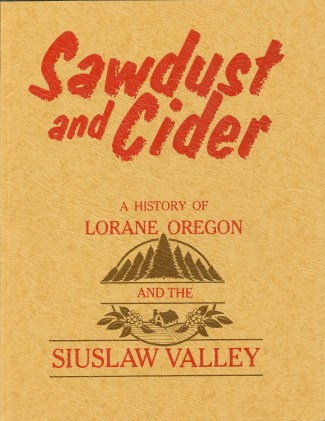
Cover.jpgIt was soon time for finding a title for the book. No one seemed to be able to come up with a catchy title. It came to me all at once without any effort once I let my mind relax its struggle. Sawdust and Cider; A History of Lorane, Oregon and the Siuslaw Valley became a reality as soon as I suggested the names to Nancy and Marna. The name referred to the sawmills and the vast apple orchards that flourished in the area during the early and mid parts of the century.

During those days of getting the book ready for publication, I contacted a newspaper in a neighboring city. They sent out a reporter who did a feature article on the writing of the book. Soon other area newspapers were contacting us. A freelance writer asked to do an article for the magazine put out by our rural power utility.

By the time that the book went to press, we had sold enough copies to pay for the printing costs. We opened a savings account where we let the remaining money accumulate for the costs of a second printing that we knew we would need.

When we brought the book home from the publishers, it was like bringing a new baby home from the hospital. We were anxious to show it off to everyone. We scheduled a book party at the Grange Hall where we invited all of those who had ordered books to come and pick up their copies. We had refreshments and a signing table where we were actually asked for our autographs. It was a day of compliments and pictures, and we basked in our collective glory.

The Lorane Centennial took place shortly after the publication of the book; almost 4 years after Nancy and Marna approached me that day. We sold enough books to order a second printing. We had donated books to local libraries and museums and had placed them in many of the area book stores. One of the bookstores arranged to have two of the area T.V. stations interview me on the air about the book. We sent one of the books to a popular genealogy journal for review, and we took out an ad in that same journal. The sales of Sawdust have slowed down considerably over the years, but we only have about 200 of the 1,500 total books that were printed remaining.

Writing a history such as ours has been work…lots and lots of work. But, in the end the knowledge that you have contributed something to the history of the area compensates for all of that hard work. You’ll never get rich writing a history such as ours; in fact, you’ll never get monetarily compensated for all of the hours that you put into it. But you will never be able to spend the rewards you get. They will remain with you for the rest of your life.

(Published in The Genealogical Helper and The Housewife-Writer’s Forum, 1995)